Schoharie Crossing State Historic Site (opens in a new tab) will host musicians Cosby Gibson and Tom Staudle as they present: “Poetry Songs and History Songs” on Sunday, June 3rd at 4:00pm. This inspiring musical performance brings together the words of famous poets and original tunes by Tom Staudle such as Robert Frost, Edgar Allen Poe, Andy Rooney, and more. Gibson’s History Song series portrays the life of the American Settlers during the Revolution in upstate New York through her original songs.
Cosby and Tom are regional musicians who focus on songwriting in acoustic and blues-style. Their new albums are both winners in the Capital District Original Music Awards, 2018, for Best Folk Album, and Best Folk Lyrics respectively.
“With guitar, violin, banjo, harmonica, and ukulele, these high-spirited independent artists present heartfelt original acoustic folk and blues.” ~ Folk Times
“Cosby and Tom are regional musicians who focus on songwriting in acoustic and blues-style, and tour in the northeast and beyond. Their new albums are both winners in the Capital District Original Music Awards, 2018, for Best Folk Album, and Best Folk Lyrics respectively.”
Schoharie Crossing State Historic Site (opens in a new tab) is extending the deadline for submissions for paintings to be included in the 2018 art show. Painters residing in New York State who want to showcase their work in a competitive, juried exhibition are encouraged to read the show description and submit original work in the theme of Lock in the Fun: Recreation at Schoharie Crossing. The deadline is now May 25th.
To recognize the centennial of the NYS Barge Canal, Schoharie Crossing is hosting this second annual exhibition of talented artists. This year the focus will be on paintings only. Jurors have accepted the task of reviewing the artwork and prizes will be awarded to those honored by the jurors.
The Erie Canal historic site and NYS Park is a great place for recreation such as walking, cycling, kayaking, fishing, birdwatching, picnics, and more; providing memories & experiences for generations. The site supplies great views of nature as well and the historic canal structures are juxtaposed among the natural world of plants and animals along the Schoharie Creek and Mohawk River. The trails along old towpaths of the canal allow for a journey back in time. Flora and fauna thrive within the tranquility of the waterways, wetlands and open spaces of Schoharie Crossing, lending great inspiration for any artist.
The Erie Canal’s vital importance is highlighted by the classic arches of the Schoharie Creek Aqueduct and the impressive lock chambers that still exist at locations throughout Schoharie Crossing. Views of the Mohawk and Schoharie Valleys can also be taken in as you explore this landscape.
Schoharie Crossing encompasses over two hundred acres and spans over three miles in length. From the western end of the site at the Aqueduct boat launch, across the Schoharie Creek and east to Yankee Hill Lock and the Putman Canal Store. The site contains portions of the original 1820’s Erie Canal as well as features two sets of double locks from the Enlarged Era Canal and is adjacent to the Erie Canal of today; the Mohawk River. Lock E12 at Tribes Hill on the river is situated close to the site and provides access to witnessing the newest century old canal of today.
All along the site there is ample opportunity to explore your artistic skills, from photography, painting, and even sketches. Discover more on the Schoharie Crossing Facebook page or on the Friends of Schoharie Crossing Instagram and Twitter.
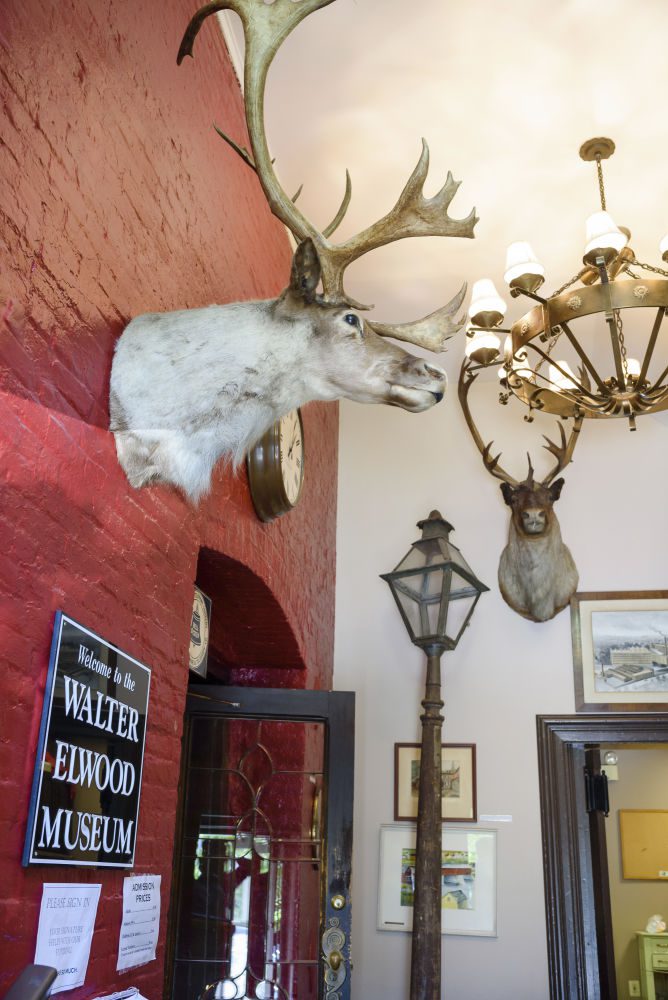
The Walter Elwood Museum (opens in a new tab) Board of Trustees and staff are proud to announce a very generous grant donation of over $10,000 from Amsterdam Center for Teens (ACT IV) Inc. to benefit the students of the Greater Amsterdam School District.
Ann Peconie, Executive Director of the Museum is extremely grateful to the ACT IV Board of Directors; including Howard M. Aison, President, John G. Putman, and Margaret H. Aison for their support in the programming and educational goals of the Walter Elwood Museum to provide FREE quality programs for students and families in our area. This grant demonstrates to the Museum Board, Staff and membership that the former Amsterdam Center for Teens (ACT IV) Board of Directors see the Walter Elwood Museum as a time-honored educational and historical organization with essential value in our community in teaching our young residents about its vibrant past. This contribution will help keep our Museum active and open to the people of our community for years to come.
This year there are 11 Author/Historian Presentation and Panel Discussion. Starting on Thursday, June 7th, Michael E. Newton will present “Alexander Hamilton’s Revolutionary War Service”. On Friday, June 8th, Russell Shorto will present “Revolution Song: America’s Founding Era in Six Remarkable Lives”.
On Saturday/Sunday, June 9th and 10th, there are the following presentations:
Edward G. Lengel – George Washington and the Burning of New York City, 1776
Eric H. Schnitzer – “Hessians” at the Battle of Bennington, 1777
James L. Nelson – Benedict Arnold’s Navy: The Story of the Rag Tag Fleet that Lost the Battle of Valcour Island and Won the American Revolution
Don N. Hagist – Redcoats Along the Mohawk: British Soldiers in Western New York, 1777-1783
Bruce M. Venter – Benedict Arnold’s Nemesis: Colonel John Brown’s Fateful Journey to the Mohawk Valley
Jennifer DeBruin – Traitors, Spies & Heroes: Loyalist Espionage in the American Revolution
Glenn F. Williams – Sir William Johnson, the Iroquois Confederacy and Lord Dunmore’s War
John Buchanan – Two Warriors: George Washington and Sir William Howe
Wayne Lenig – The Tryon County Committee of Safety
New this year, a Panel Discussion where presenters and the audience will discuss which side they would choose, Patriot or Loyalist?
On Thursday, June 7th, there is a Bus Tour of the 1778 Battle & Raid Sites. The bus tour will feature the events of 1778; the Battle of Cobleskill, the Cherry Valley Massacre, Springfield, Andrustown, Adam Helmer’s Run, Fort Herkimer and Fort Plain/Rensselaer (opens in a new tab) . There is a lunch stop in Cooperstown.
New this year, is a Genealogy Day, this is held on Friday, June 8th. Guests can visit the Mohawk Country (opens in a new tab) historic sites located throughout Montgomery County. Sites will have presentations and/or historians on hand to discuss the families that fought on both sides during the American Revolution.
On the evening of Saturday, June 9th, “An Evening with Washington and Madison” including an all new Fundraiser Dinner held at the Bridge Walk at the Perthshire (opens in a new tab) . Join George Washington and James Madison, portrayed by Brian Hilton and Kyle Jenks, as they discuss their journeys to upstate New York and other founding moments.
New Research Sheds Light on Canalway Corridor Visitors
The Erie Canalway National Heritage Corridor today released results from a recently-commissioned study about current and prospective visitors to the 500-mile Canalway Corridor. The information is intended to help tourism promoters, businesses and heritage sites better attract and serve visitors, including boaters, cyclists, sightseers and vacationers. “This new research really helps us understand who visits, what attracts them, the kinds of activities they engage in, and what they think of their experience. We are grateful that so many people took the time to offer their feedback and insights,” said Bob Radliff, Executive Director of the Erie Canalway National Heritage Corridor Ross D. Levi, New York State Executive Director of Tourism, said, “The Erie Canal is a tourism crown jewel for New York State, providing countless opportunities for residents and visitors alike to discover its history, enjoy its water activities and explore its attractions in surrounding towns and villages. This study will help our tourism partners better understand canal visitors, which will help their marketing efforts and continue to increase tourism statewide.” More than 1,000 people participated in online surveys and 20 provided in-depth interviews conducted by Rochester-based Level 7 Market Research on behalf of the National Heritage Corridor. Visitors and prospective visitors who live near the canal system, as well as those from other parts of New York and neighboring states, participated, providing a reliable and geographically-diverse research sample. Among the findings:
Recent and prospective visitors were drawn to the history of the area and to exploring local canal communities; boat tours/boating and attending festivals/events are major draws among prospective visitors.
Most recent visitors rated their experience high— 8 out of 10.
70% of visitors who live in the Canalway Corridor selected “Always been curious about the area” and “Destination for personal journey/accomplishment” among their top reasons for visiting.
Recent canal visitors tend to be older, travel in smaller parties, and have higher income households compared with prospective visitors. Most are savvy travelers who are three times more likely to travel internationally.
Lack of awareness and knowledge are among the greatest barriers to visiting.
The research was funded by a grant from Market NY through I LOVE NY, New York State’s Division of Tourism, as a part of the State’s Regional Economic Development Council initiative.
The full study is available at:https://eriecanalway.org/our-work/promote-tourismThe Erie Canalway National Heritage Corridor spans 524 miles across the full expanse of upstate New York, encompassing the Erie, Cayuga-Seneca, Oswego, and Champlain canals and their historic alignments, as well as more than 230 canal communities. Erie Canalway National Heritage Corridor Commission and the Erie Canalway Heritage Fund work in partnership to preserve the region’s extraordinary heritage, to promote the Corridor as a world class tourism destination, and to foster vibrant communities connected by the waterway. www.eriecanalway.org
Indiana Jones and Fort Plank: The Cleaner Side of Archaeology
Join Schoharie Crossing State Historic Site on Tuesday, September 26th as researcher Ken D. Johnson delivers his presentation, “Indiana Jones and Fort Plank: The Cleaner Side of Archaeology.”
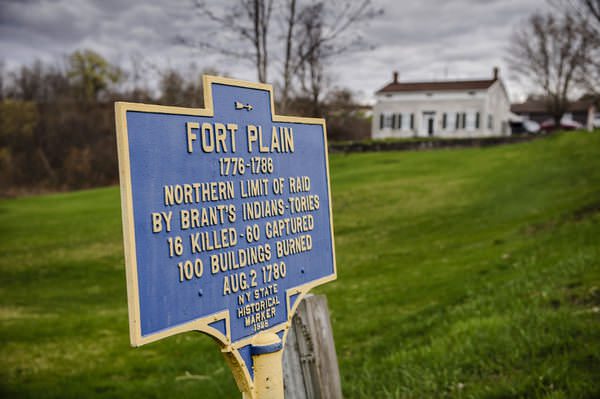
The program takes the audience along with Ken on a search for the fortress in which his ancestors served during the American Revolution. From this fort, one of them was taken prisoner on August 2, 1780, and their father and sister were killed. His program also presents to the audience the first step in locating a site for a possible historical dig.
Johnson has served as the Fort Plank Historian since 1984 and is the author of “The Bloodied Mohawk: The Revolutionary War in the Words of Fort Plank’s Defenders and Other Mohawk Valley Partisans”. He also operates a free web-site that contains biographical and historical data on the Colonial Period in the Mohawk Valley of New York.
This free program will be held in the Enders House adjacent to the Schoharie Crossing State Historic Site Visitor Center on Schoharie Street in Fort Hunter, New York. There will be a brief Friends of Schoharie Crossing meeting prior to the presentation and there will be refreshments available.
For more information about these events and more, please call the Visitor Center at (518) 829-7516; email: SchoharieCrossing@parks.ny.gov. New York State Office of Parks, Recreation and Historic Preservation oversees 180 state parks and 35 historic sites, which are visited by 60 million people annually. For more information on any of these recreation areas, call 518-474-0456 or visit www.nysparks.com, connect on Facebook, or follow on Twitter.
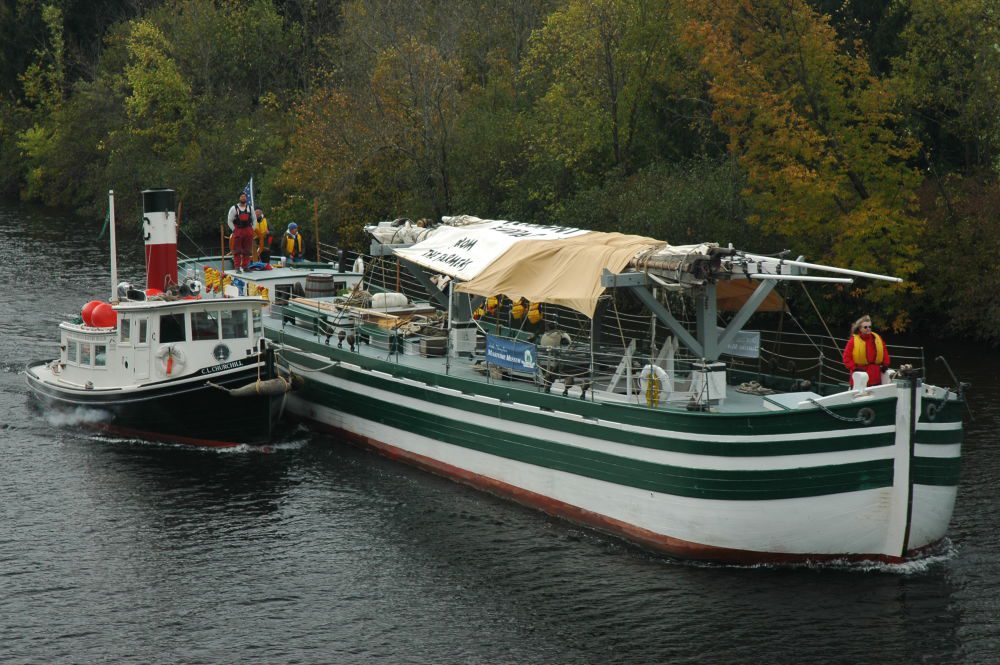
Replica 1862 Canal Schooner Lois McClure on the Champlain Canal – Stern. Courtesy Lake Champlain Maritime Museum
Lake Champlain Maritime Museum’s (LCMM’s) replica 1862 canal schooner LoisMcClure (opens in a new tab) will be in port at Riverlink Park in Amsterdam on Thursday, July 13 from 12-6pm and Riverfront Park in Canajoharie on Friday, July 14 from 4-7pm during her 2017 Legacy Tour commemorating the Erie Canal Bicentennial. The World Canals Conference, which celebrates canals as “agents of transformation,” inspired the 2017 “Legacy Tour” of Lois McClure. The tour pays tribute to the legacy of the canals, which celebrate 200 years in 2017, and the legacy of the Northern Forest trees, which built the thousands of wooden boats that plied our waterways. Visitors can board the schooner free of charge to explore the 88-foot long boat and a special exhibit.” “The Lois McClure has a unique capability to bring 200 years of canal history to life, while engaging people to appreciate and protect our legacy waterways,” says New York State Canal Corporation Director Brian U. Stratton. “It can also help inform how the canal system can best serve the evolving needs of present and future generations.”
During the Legacy Tour the schooner crew will share with community members and students a maritime perspective on the relationship between waterways and trees, canal boats and forests through an initiative called Stem to Stern. “The forests and the waterways are a key to understanding how America transformed into a powerful and prosperous nation,” says Erick Tichonuk, LCMM Co-Executive Director. “Using human and animal power, the canal builders cleared a pathway 60 feet wide and more than 400 miles long, much of it through forested lands, to create the water highway that brought an economic boom. Almost overnight, natural resources too bulky to ship overland became valuable commodities.” The canals opened a floodgate of trade between the Champlain Valley, ports along the Hudson River and the Atlantic Seaboard, and through western New York to the Great Lakes.
However, the transformation also brought some unintended consequences. Stem to Stern is designed to spark insight into the impact of deforestation: eroded soil, silted waterways, loss of habitat for fish and wildlife, and the arrival of invasive species. Marking the transition to an era of habitat for fish and wildlife, and the arrival of invasive species. Marking the transition to an era sustainable forestry and environmental stewardship, the schooner will transport a cargo of white oak and white pine seedlings provided by New York State Department of Environmental Conservation’s Trees for Tributaries Program, to be planted in communities along the canal.
Further information and the full itinerary of the 2017 Legacy Tour can be found at www.lcmm.org (opens in a new tab) . Travel conditions for this traditional wooden vessel are weather dependent, so the schedule is subject to change.
Lois McClure was built by LCMM shipwrights and volunteers on the Burlington waterfront, based on two shipwrecks of 1862-class canal schooners discovered in Lake Champlain. Since 2004, Lois McClure has cruised Lake Champlain, the Hudson and St. Lawrence Rivers, and the Erie Canal System, and has visited over 200 communities and welcomed aboard more than 225,000 visitors. As an authentic replica, Lois McClure has no means of propulsion other than sail, so 1964 tugboat C. L. Churchill serves as power. As with all wooden vessels, constant care and maintenance is needed to ensure safe and effective operation.
Schooner Lois McClure is an educational outreach program of Lake Champlain Maritime Museum (LCMM), Vermont. A museum with a difference, LCMM brings underwater discoveries and lake adventures to the public in exciting and imaginative ways. The Museum is open daily from 10 a.m. to 5 p.m. through October 15, 2017. For more information visit www.lcmm.org (opens in a new tab) or call (802) 475-2022.
Your journey begins in Canajoharie (Exit 29 off the New York State Thruway) at the Van Alstyne Homestead (opens in a new tab) . According to family tradition, the original structure was built by Martin Van Alstyne as early as 1729. By 1765 son Goshen Van Alstyne had converted and expanded the house to a colonial tavern. The tavern became a frequent meeting place of the Tryon County Committee of Safety and is the place where Nicholas Herkimer received his commission as General of the Tryon County Militia.
Continue your travels west on State Highway 5S to Fort Plain. The Fort Plain Museum & Historical Park (opens in a new tab) is the site of the original Fort Plain also known as Fort Rensselaer. The construction of Fort Plain began in the late fall of 1778 after the Cherry Valley Massacre convinced locals of the need for a haven in the event of enemy attack. By 1781 the fort had become an important Continental Army Depot for the western Mohawk Frontier and was inspected by General Washington in August of 1783.
Also located in Fort Plain is the Isaac Paris House (opens in a new tab) . In 1777 Isaac Paris, Sr. was killed at the Battle if Oriskany making Isaac Paris, Jr. sole owner of the Paris holdings. Paris was an accomplished businessman who served as the business representative for Washington’s major general, the famed Baron de Steuben, a regular guest at the house and nearby Fort Plain.
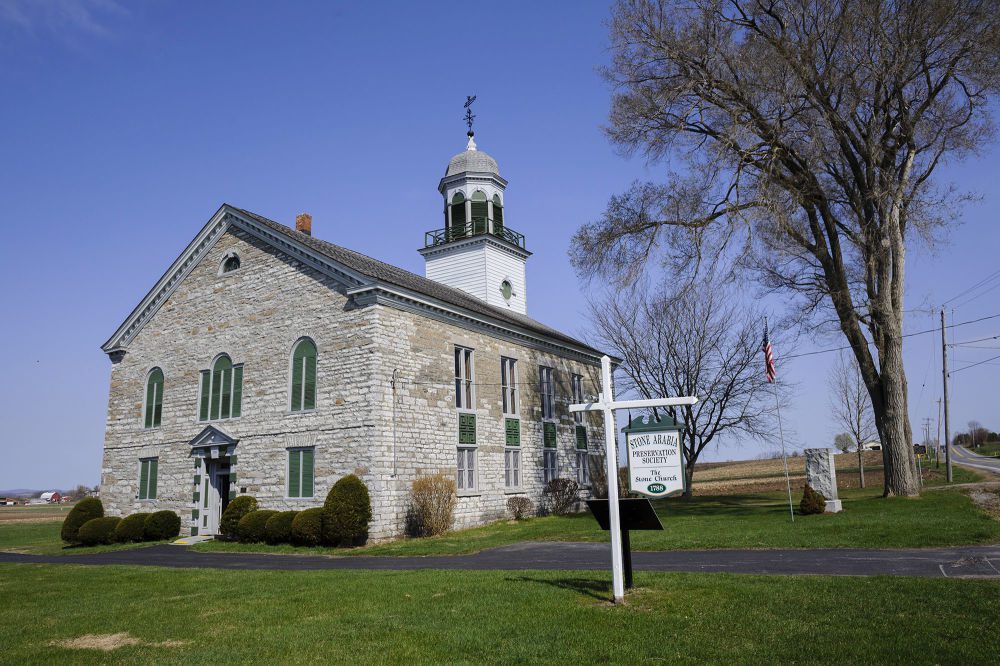
From Fort Plain, cross the Mohawk River to Nelliston following Hickory Hill Road to the historic farming community of Stone Arabia. Visit the Stone Arabia Dutch Church (opens in a new tab) burned by the British in October of 1780 during the Battle of Stone Arabia. It was rebuilt in 1788 and has remained unchanged since. The cemetery behind the church is the final resting place of Patriot leader Colonel John Brown of the Berkshire Massachusetts Militia killed in the battle on October 19th. Historic marker signs along Route 10 mark the locations of engagements and forts involved in the battle.
Continue westward, following the old Stone Arabia Road, to the Palatine Church (opens in a new tab) of “Drums Along the Mohawk” fame. The historic church was erected in 1770 and is the oldest church standing in Montgomery County. It was built by German Palatine settlers who originally migrated to America from the Palatine region of Germany in 1710.
Next is Fort Klock (opens in a new tab) , a fortified homestead built circa 1750 by Johannes Klock, a German Palatine who came to the area with the great Palatine migration. On October 19, 1780, the Battle of Klock’s Field was fought just west-northwest of the fort.
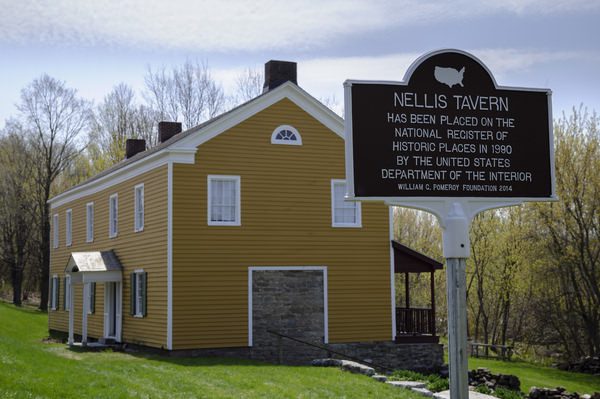
Located less than a mile west of Fort Klock is the 1747 Nellis Tavern (opens in a new tab) , an historic inn and tavern. Built by Christian Nellis, Sr., as a farmhouse, was expanded to its present form about 1800 with the construction of the Mohawk Turnpike. The original timber-frame clapboard structure survived the French and Indian War and the American Revolution.
St. Johnsville is also the home of the Margaret Reaney Memorial Library (opens in a new tab) which houses a collection of fine art, sculpture, and historically important memorabilia. Spanning many years, from pre-Revolutionary to present time, the exhibits reflect the rich cultural heritage of the Mohawk Valley.
The Montgomery County Anti-Slavery Society was organized at the Presbyterian church (now the Calvary Reformed Church) in Hagaman in 1836. This was the county’s first official stance against the institution of slavery. Many local abolitionists were instrumental in organizing this society. A marker is placed outside of the church signifying its importance in the anti-slavery movement.
Green Hill Cemetery in Amsterdam – Self-guided Walking Tour
23 Cornell Street, Amsterdam
Abolitionism and African American Life in Amsterdam (opens in a new tab) : Amsterdam, referred to by some as “the abolition hole,” was a hotbed of activity in the anti-slavery movement that swept the country in the years leading up to the Civil War. Many of the local prominent residents participated in the cause to assist those seeking a life of freedom. The area’s black residents also participated in the fight to end slavery with the Civil War. A number of those participants, black and white, have their final resting place here at Green Hill Cemetery.
Canajoharie – Self-guided Walking Tour
Begin on Cliff Street, Canajoharie
The walking tour (opens in a new tab) focuses on the sites associated with the African American residents and the anti-slavery movement in the Village of Canajoharie. The brochure identifies sites with the village, those still existing and those that are gone with the passage of time.
Dr. James Mereness participated and organized anti-slavery meetings for the western part of Montgomery County for many years prior to the Civil War. Reports indicate that fugitive slaves seeking freedom from their lives in servitude sought shelter in Mereness’ home as part of the Underground Railroad network. Dr. Mereness died in 1872, at which time, he continued his interests in improving the lives of African Americans through bequests to educate them.
The top floor of the 1835 Ames Museum, used as an academy from 1839 to 1959, houses many local artifacts featuring Ames’ hey-day as the hops-growing capital of 19th Century America. This building was listed on the National Register of Historic Places in 2002.
I LOVE NY started the “New York Fall Foliage Report” on September 14 and continue until the end of the foliage season, around the first or second week in November. Montgomery County has started its own annual report this year as well.