Cookies

We use cookies and related technologies to personalize and enhance your experience. By using this site you agree to the use of cookies and related tracking technologies.

Privacy Policy

Options

Events

Schoharie Crossing State Historic Site Seeks Participants for the 2016 Canal Days

Schoharie Crossing State Historic Site (opens in a new tab) is planning for the 2016 Canal Days to be held on Saturday, July 9th and Sunday, July 10th around the Visitor Center in Fort Hunter, NY.  This annual event is a fun mix of games, food, music, education, recreation, a car show and more! The event attracts visitors from all over the region to the site and community. 

The historic site is seeking participants from community organizations, local crafters, vendors and groups that may wish to be a part of this terrific event. The historic site features acres of space available for the festival and activities. Free parking will be available.

For more information, please contact Janice at the site (518) 829-7516 or Schoharie.Crossing@parks.ny.gov.  


Schoharie Crossing Annual Winter Writing Contest

Schoharie Crossing writing emblemSchoharie Crossing State Historic Site (opens in a new tab) is once again conducting a Winter Writing Contest (opens in a new tab) .  This year the contest is asking for poems to be written by children as well as adults. Local judges will read, review and select winners for each of the three categories: Child (up to 12 years old), Young Adult (13-17), and Adult (18 and up). 

Traveling on the canal was always quite the experience.  It could often be difficult and dangerous or it could also be a way to a better life.  That diversity of experiences from Albany to Buffalo along the artificial river meant that each person had a unique story to tell.  For this year’s contest, the site is asking that submissions of poems that express your own interpretation of a travelers experience on the Erie Canal be sent in no later than 5pm on April 6th.

Each poem should demonstrate an understanding of the social, economic and engineering systems that were part of traveling across New York State on the Erie Canal.  Your poem could be set during any era of canal travel, from the 1820’s up until today.

Prizes this year are $100 each for the Adult category, Young Adult and the child category.  Submissions may be sent via mail to Schoharie Crossing Writing Contest, P.O. Box 140, Fort Hunter, NY 12069, or electronically to: SchoharieCrossing@parks.ny.gov

For contest topics, rules and guidelines or other information, please contact the site or find us on Facebook (opens in a new tab) .  (518) 829-7516.


MONTGOMERY COUNTY RECEIVES PRESERVATION LEAGUE GRANT

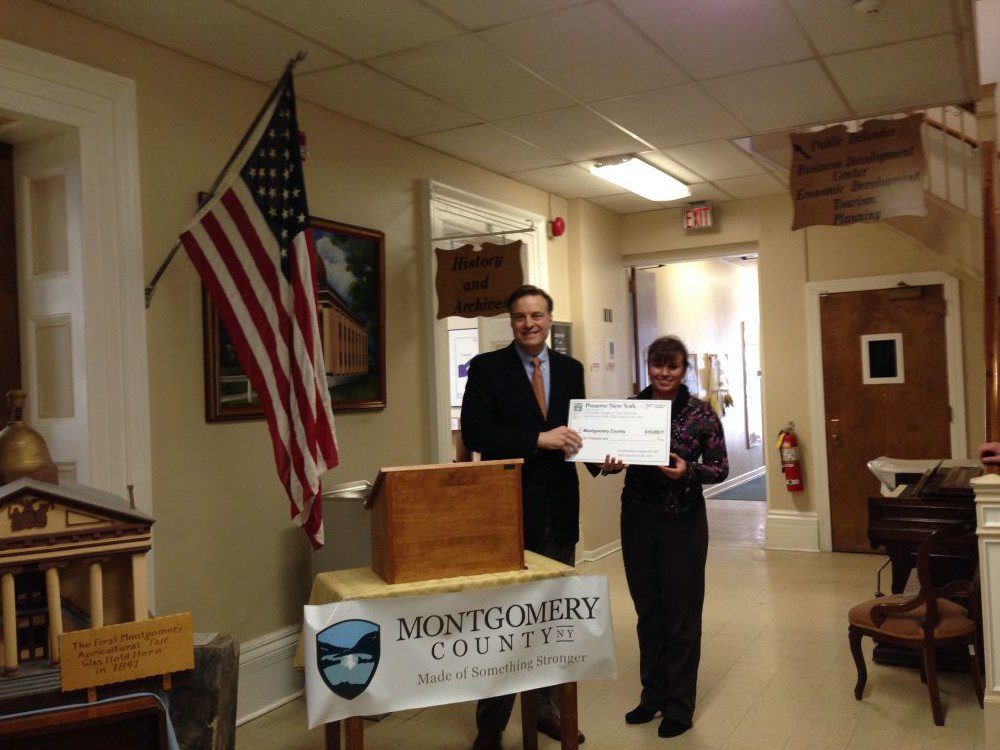
Recently the Montgomery County Department of History & Archives (opens in a new tab) received a $10,000 Preserve New York grant from the Preservation League of New York State (opens in a new tab) to support the cost of a reconnaissance level survey of rural resources in Montgomery County.

Jay DiLorenzo, President of the Preservation League, presents Kelly Farquhar, Montgomery County Historian, with a $10,000 check.

This project will serve as the first phase of the creation of a standardized, broad-based survey of Montgomery County. This first phase will survey the county’s westernmost towns including St. Johnsville, Palatine, Mohawk, Minden and Root. The rural resources in question are significant within the larger geographic and cultural setting because they are located among historic land divisions and transportation corridors, namely the Erie Canal.

The project will help the county develop a preservation plan to highlight its rich history. If the survey leads to National Register (opens in a new tab) designations, property owners could qualify for the NYS Rehabilitation Tax Credit. The survey will not include village centers or resources previously listed on the National Register. Jessie Ravage of Cooperstown will be the administrator of this project.

“I believe that the history of Montgomery County is one of our greatest and most important resources and one that adds character to our rural communities,” said County Executive (opens in a new tab) Matthew L. Ossenfort. “As the first step in this detailed process, the county will assess the historic buildings and landmarks in towns in the western part of the county. This will lead us toward the creation of a working plan to preserve our historic treasures. Identifying and maintaining these historical buildings not only safeguards our traditions and our history, but enhances the benefits of heritage tourism, which can be an important economic driver for the county and the region.”

The Preserve New York Grant Program is made possible by the New York State Council on the Arts with the support of Governor Andrew Cuomo and the New York State Legislature. “With the announcement of the 2015 awards, the total support provided by Preserve New York since its launch in 1993 is just over $2 million to 320 projects statewide,” said Jay DiLorenzo, President of the Preservation League. “Preserve New York has a strong track record of bolstering local preservation efforts and delivering a strong return on investment.”

“At its August, 2015 meeting, the Preserve New York grant program panel selected 14 applicants in 11 counties around the state to share $114,990 in funding,” said Erin Tobin, the League’s Director of Preservation. “As always, the competition for these funds was intense. The Preservation League is delighted to help advance the preservation efforts of Montgomery County with timely funding from Preserve New York.”

For more information on the Preserve New York Grant Program, please call 518-462-5658 x 10 or visit the League’s website at www.preservenys.org (opens in a new tab) .

African American Life & Abolitionist Movement in Canajoharie

A Walking Tour of Canajoharie

African American Life and the Abolitionist Movement in Canajoharie

Henry & Mary Miller (Cliff St.): Both born into slavery, Henry and Mary (Garlock) Miller were emancipated with the 1827 law.  They lived on this site where they raised a large family.

Peter & Eliza (Miller) Skinner (Cliff St.): Peter and Eliza Skinner represent the successful integration of many African Americans, born of enslaved parents, into the community life of these Mohawk Valley villages.  Both Peter and Eliza became property owners and successful business people in Canajoharie.

African Methodist Episcopal (A.M.E.) Zion Church (Cliff St.): Five African American men, representing African Americans who had been meeting for some time in a local church assembled to incorporate the African Methodist Episcopal Zion Church at Canajoharie.  They purchased a plot of land on Cliff Street, just east of the home of Peter and Eliza Skinner.  Whether or not they actually built a church there is not known.  This church incorporated in 1857.  The denomination was synonymous with notable abolitionists such as Harriet Tubman, Frederick Douglass, and Rev. Jermaine Loguen.  Rev. Richard Eastup, a freedom seeker himself, was appointed to oversee the Canajoharie mission church i 1862.

Charles Walter & Frances (Skinner) Denning (Cliff St.): Built sometime after 1868, this house was the home of Walter and Frances Denning, African Americans, by 1905.  Walter Denning was a Civil War veteran who became a prominent mason and brick worker in Canajoharie, who most likely used limestone quarried near this house.  Denning’s father actively shepherded freedom seekers from his home near Elmira.  Frances Skinner Denning grew up with her parents in a house just east on Cliff Street.

Philip Phillips (corner of Wheeler & Otsego Streets): As the generation of African Americans who were once enslaved, Philip and Eunice Phillips represent the modest success that steady work and home ownership provided to people who spanned the experience of both slavery and freedom in the Mohawk Valley in the mid-nineteenth century.

Canajoharie Academy (Otsego St.): As headmistress of the female department, Susan B. Anthony taught from 1846-1849 in the building that stood on this spot.  One cousin called her “the smartest woman in Canajoharie.”  Here she began her public career as a reformer, when she gave her first lecture for temperance on March 2, 1849.  She resigned in 1849 to move to Rochester, where she lived with her parents and began her career in abolitionism and women’s rights.  The current structure was designed by Archimedes Russell and built in 1892.

Ehle Block (Rock & Cliff Streets): erected 1876 by Eliza Ehle replacing an earlier home that had burned; housed various businesses including Peter Skinner’s barbershop and his wife Eliza Skinner’s ice cream parlor.

Reformed Church (Front St.): Like many churches in Montgomery County, European Americans dominated this congregation, but many African Americans  were also members.  Philip Phillips and his wife Eunice Van Horn Phillips were both members of this church; Philip Phillips was also sexton.

United Methodist Church: organized in 1828 in Palatine Bridge; built on this site in 1841; new structure erected after 1915 fire; had antislavery lectures including former slave Henry Walton Bibb. Many black families had their children baptized here.

John C. Smith: As a teacher and later President of the Canajoharie National Bank, Smith was one of those Canajoharie residents who, in 1850, signed and sent a petition to Congress denouncing slavery and forbade further admittance of any slave state to the Union.

Shaper Block (northwest corner of Church & Mohawk Streets): first building burned 1891; housed the barbershop of James Teboet.  The second building on this site, constructed of brick, burned and was razed in 1973.

George & Eleanor (Read) Caldwell (Mohawk St.): Susan B. Anthony first stayed at the home of her cousin Eleanor (Read) and George Caldwell during her tenure at the Canajoharie Academy.  As a conservative Democrat, George Caldwell introduced Anthony to local and state wide political debates, helping Anthony to define her own commitment to abolitionism.

James & Sarah Teboet/John & Mary Cromwell (Mohawk St.): James Teboet learned the skill to be a barber and practiced his trade in the Sharper building just down the street to the east of his home.  John Cromwell, residing in the same house, learned to play the violin while a slave in Schoharie County.  Hi s orchestra was well known throughout the Mohawk Valley playing at many halls and events.

Chester “Bromley” & Lizzie (Phillips) Hoke (Mohawk St.): Bromley Hoke and Elizabeth Phillips Hoke represent the integral part of that African Americans, descendants of grandparents who had been locally enslaved, played in the economic and social development of the Mohawk Valley, as well as the close ties of family and neighborhood that sustained African American families as they moved from slavery into freedom.

George Gilbert (Mohawk St.): Gilbert worked as a teamster and served as trustee for the A.M.E. Zion Church during its incorporation and its dissolution.  Also a member of the St. Mark’s Lutheran Church, Gilbert was a prominent member of Canajoharie’s black residents.

For a copy of the Canajoharie tour map and more information on the Underground Railroad, Abolitionism and African American Life in Montgomery County project, please contact the Montgomery County Department of History & Archives (opens in a new tab) at (518) 853-8186.


 

Abolitionism and African American Life in Amsterdam

A Tour of Green Hill Cemetery

Amsterdam, referred to by some as “the abolition hole,”* was a hotbed of activity in the anti-slavery movement that swept the country in the years leading up to the Civil War.  Many of the local prominent residents participated in the cause to assist those seeking a life of freedom.  The area’s black residents also participated in the fight to end slavery with the Civil War.  A number of those participants, black and white, have their final resting place here at Green Hill Cemetery.

Abolitionism and African American Life in Amsterdam

Bruce Anderson (1845-1922): Believed to have been born in Mexico, Bruce Anderson was one of the few African Americans to have been awarded the Congressional Medal of Honor for his service in the Civil War, participating in the assault on Fort Fisher in North Carolina.  Julia Anderson (1858-1914), Bruce’s second wife, was descended from slaves.

Charles (?-1903) & John Ceasar (1843-1906): Longtime residents of Amsterdam who may have been descended from those who were locally held in slavery.  The Ceasar family attended the A.M.E. Zion Church on Cedar Street.

Helen Blood (1830-1901) & Henry Blood (?-1876): Longtime residents of Amsterdam.  Henry may have been born into slavery.

Ellis Clizbe (1797-1878): Abolitionist and lecturer; Member of the Eastern New York Anti-Slavery Society and founding member of Amsterdam and Montgomery County Anti-Slavery Societies.  Clizbe sheltered fugitive slaves at his Rockton farm.  His views on slavery rooted in his Christian faith, Clizbe organized anti-slavery meetings across New York State.

Chandler Bartlett (1800-1884): Abolitionist; operated a shoe store on Main Street in Amsterdam from 1820 until after 1870.  Bartlett reportedly sheltered fugitive slaves in his store before sending them on their journey to freedom.

George Washington J. Brownson (1800-1867): Prominent resident of Amsterdam; broom corn grower/manufacturer and enthusiastic abolitionist” who assisted Chandler Bartlett with sending “freedom seekers” along to Canada.

John/James Dennis (1843-1914): Born in Rockton, Dennis was likely a neighbor of Ellis Clizbe.  He was a Civil War veteran of the 31st NY Regiment US Colored Troops and member of the E.S. Young Post Grand Army of the Republic.

Benjamin H. Dennis (1844-1872): Born in Rock City section of Amsterdam, Dennis was likely a neighbor of Ellis Clizbe.  He served as a Private in Co. I of the 31st NY Regt. of the US Colored Troops.

Amos King (?-1908): King settled in the North Bush section of the Town of Caroga in Fulton County before enlisting and serving in Co. G of the famed 54th Massachusetts Colored Regiment where he fought valiantly in many battles including Olustee.

James H. Bronson (1826-1909): Broom manufacturer and member of Green Hill Cemetery Association board; abolitionist who helped to establish St. Paul’s A.M.E. Zion Church on Cedar Street near his home and place of business.

Henry M. Neff (?-?): Along with Ellis Clizbe and others, Neff signed an “Action on Slavery” in 1849 address to the Presbyterian Church refusing an ecclesiastical authority that allowed slaveholders as members.

John Kellogg (1826-1911): Industrialist and prominent resident of Amsterdam, Kellogg was part of the movement for temperance reform and he may have been involved in anti-slavery activity at his home on Church Street, along with neighbor Chandler Bartlett.

Betsy Reynolds Voorhees (1790-1858): Abolitionist; prominent Amsterdam resident who, while raising four sons, took an active role in social causes, including abolition.

John S. Maxwell (1845-1929): Knitting mill manufacturer turned attorney and city judge, Maxwell, himself a Civil War veteran, filed for pensions for other local veterans of the Civil War including Bruce Anderson.

For a copy of the Green Hill Cemetery tour map and more information on the Underground Railroad, Abolitionism and African American Life in Montgomery County project, please contact the Montgomery County Department of History & Archives (opens in a new tab) at (518) 853-8186.
 

*E.B.M., “Underground Railroad Again: Its Operations as Seen at Amsterdam, New York,” Springfield Republican, April 9, 1900