

The American Revolution was not a distant story here in Montgomery County, but a lived and fiercely contested struggle in the Mohawk Valley of New York State.
Before it became Montgomery County, this was Tryon County, one of the most contested regions in Revolutionary New York. From the Tryon County Committee of Safety’s Stone Arabia Resolves supporting patriots of Boston in the wake of the infamous Tea Party to the Liberty Pole uprising in 1775, from the construction of Fort Plain to Gen. George Washington’s celebratory visit in 1783 – Montgomery County and the Mohawk Valley preserve stories of resistance, survival, military action and community resilience that shaped the Revolution in New York State.
Explore Revolutionary history in New York beyond well-known battle sites like nearby Saratoga and take a deeper dive into the people, places, battles, raids and resilience that shaped the fight for independence.
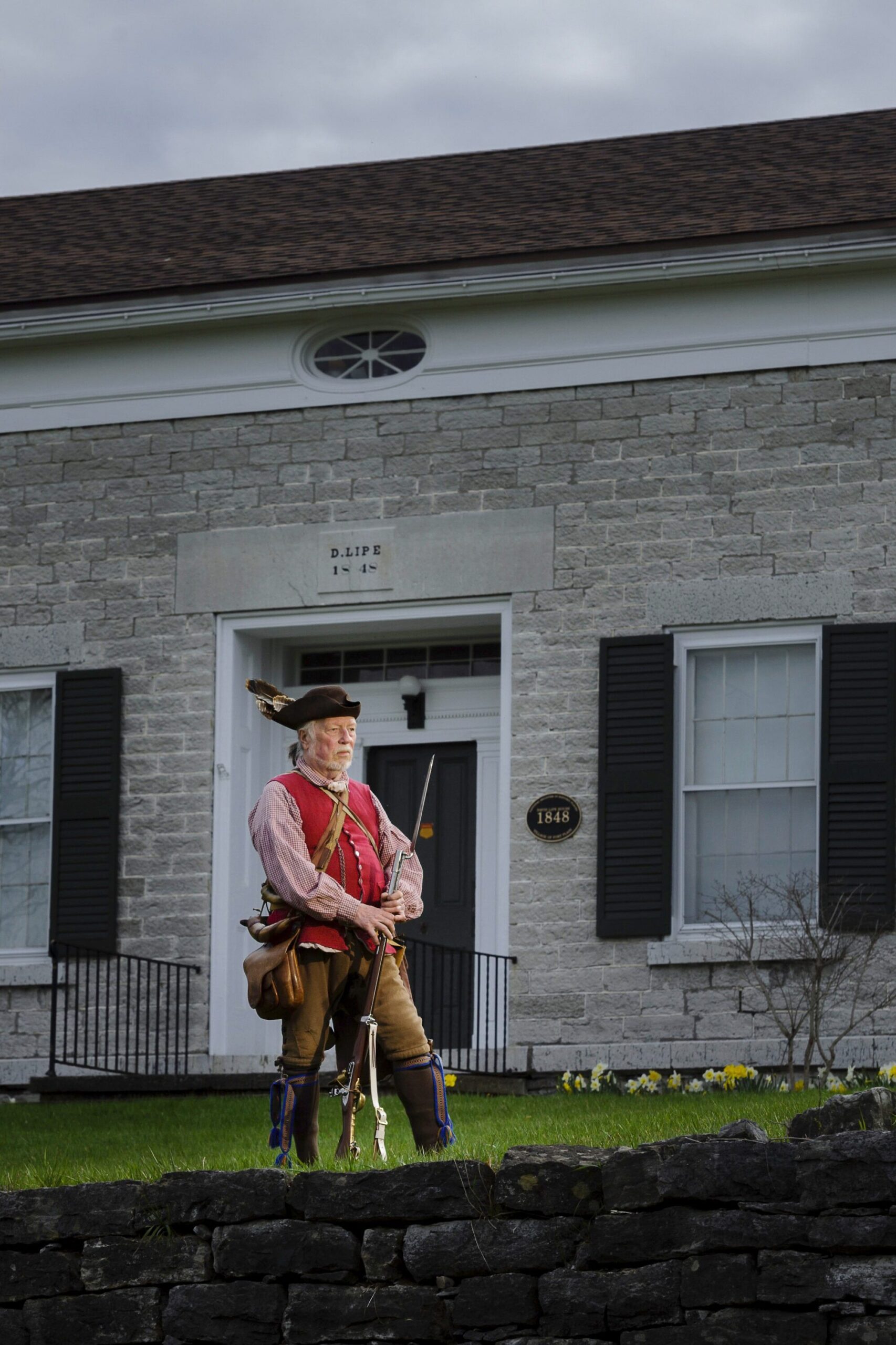
Montgomery County historic sites and museums bring the perseverance and pride of early Americans to life today through reenactments and special America 250 events in 2026 and beyond. Montgomery County invites visitors to explore Revolutionary War lore in a place that preserves America’s 250th anniversary with New York’s most compelling Revolution-era sites and most riveting stories.
The American Revolution in Montgomery County
Van Alstyne Homestead
The Van Alstyne Homestead was built in 1749 by Martin J. Van Alstyne. Here in Canajoharie, 16 of 31 meetings of the Tryon County Safety Committee were held in 1774-75. Gen. Herkimer also received a commission as Brigade General here in 1775.
Today, the Van Alstyne Homestead Society is the volunteer organization dedicated to preserving the building, collections and extraordinary history of the Van Alstyne house.
Liberty Pole Uprising
Just weeks following the battles at Lexington and Concord, a gathering of approximately 300 local inhabitants met near the John Veeder mill, west of the Cayadutta Creek, to raise a Liberty Pole supporting the effort to denounce British authority in the colonies. Upon the arrival of a group led by Sir John Johnson to stop the raising of the liberty pole and disperse the crowd, a conflict ensued when young Jacob Sammons was severely beaten for calling Johnson a villain and a liar, thus marking the first bloodshed of the Revolutionary War in the Mohawk Valley.
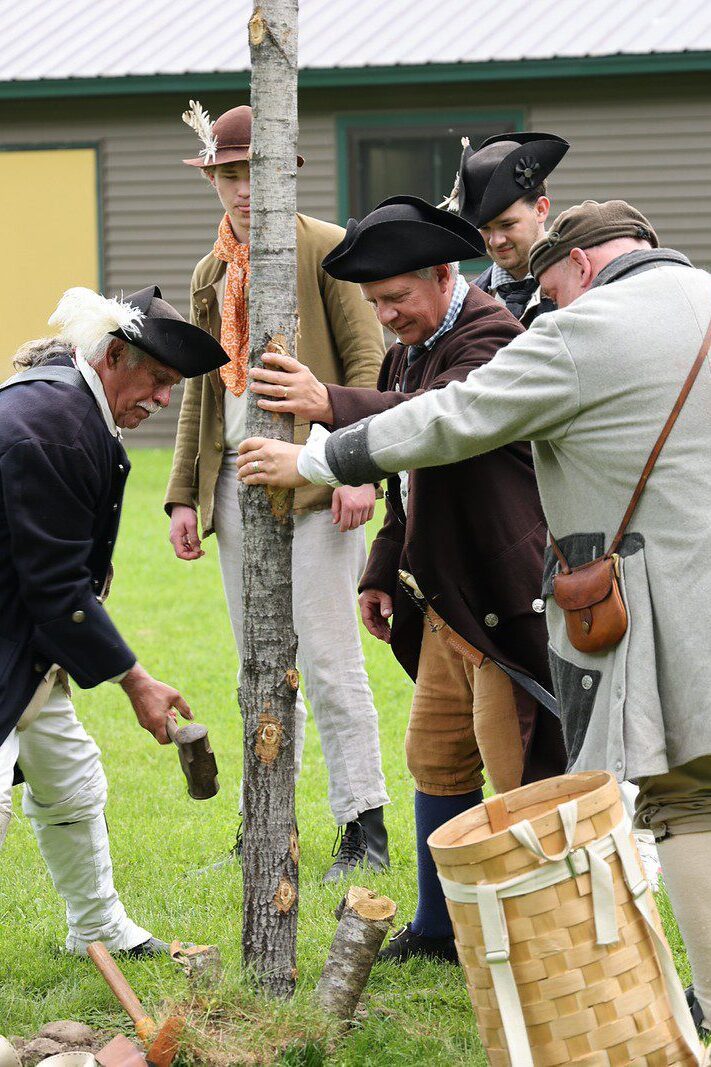
A replica Liberty Pole was erected in May 2025 at the Saint Kateri National Shrine and Historic Site to commemorate the event.
Fort Plain
A military outpost erected near Sand Hill during the Revolutionary War became known as Fort Plain. On August 2, 1780, a raid on Fort Plain was led by Joseph Brant, a corn planter, and approximately 500 Loyalists and Native Americans. Crops, homes and the Sand Hill church were burned, some residents were killed and others taken captive. Those not killed or taken captive ran to the fort for protection upon hearing the alarm. Most of the soldiers stationed at the fort were away on a mission, so the women donned men’s uniforms, stood on the parapet and intimidated the enemy into not attacking the fort.
In the summer of 1783, General Washington decided to visit the upstate New York area before returning home to Mount Vernon. On July 28, Washington reviewed the troops at Fort Rensselaer (Fort Plain) and received a welcome worthy of the Commander-in-Chief.
Using Fort Rensselaer as his base, the Commander-in-Chief visited forts, and Battle and raid sites upriver as far as Rome, New York, and south as far as Cherry Valley and Otsego Lake. On August 2, Washington returned again to Fort Plain to commemorate the Canajoharie Raid with the officials of Tryon County in a great celebratory banquet.
Today, the Fort Plain Museum & Historical Park spans 75 acres containing dozens of structures and historical sites. The museum hosts the annual American Revolutionary War Conference, a premier gathering of enthusiasts and experts as well as reenactments, which are also part of regular programming.
Fort Klock
Fort Klock served as a self-sufficient refuge during both the French and Indian War and the Revolutionary War, offering sanctuary to family and neighbors amidst turbulent times. Reflective of the region’s history, several fortified homes dot the valley. Johannes (John) Klock, a patriot and member of the Tryon County Committee of Safety, constructed the stone house for his family in 1750, with a kitchen addition added in the 1760s. Positioned along the river and King’s Highway, the Klocks and their fellow valley residents likely hosted notable historical figures during and after the Revolution. Notably, the Battle of Klock’s Field, the last skirmish of the devastating 1780 loyalist raid, is believed to have occurred nearby. On October 19, 1780, British forces were defeated in Revolutionary War battle, ending their raid of the Mohawk and Schoharie valleys.
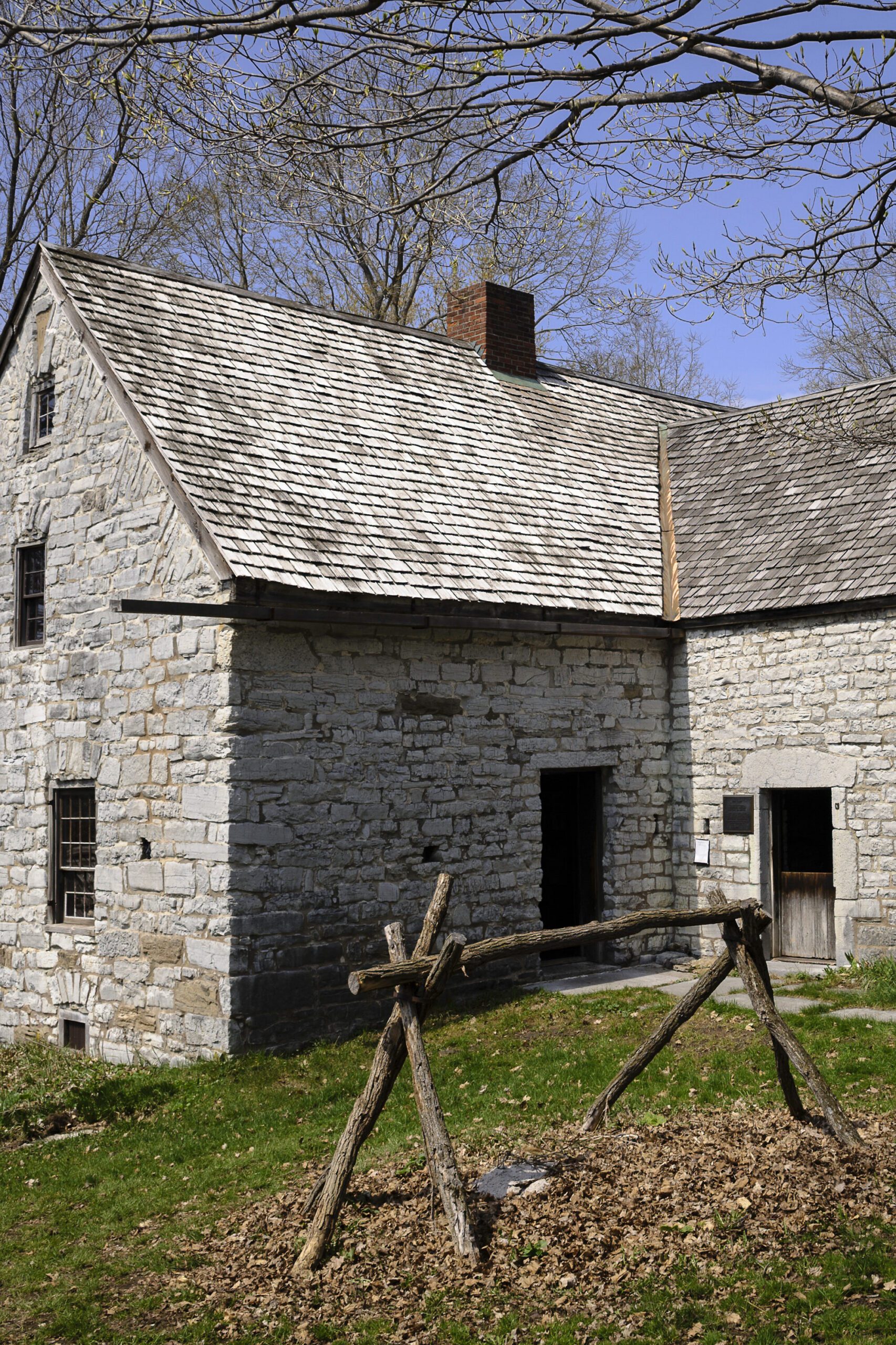
Today, the Fort Klock Historic Restoration remains a portal to 18th-century life on a functioning farm and fortified dwelling in the Mohawk Valley. Through engaging living history demonstrations and meticulously reconstructed living spaces, dedicated interpreters, members and reenactors strive to offer a compelling educational journey into this pivotal era of American history.
Stone Arabia
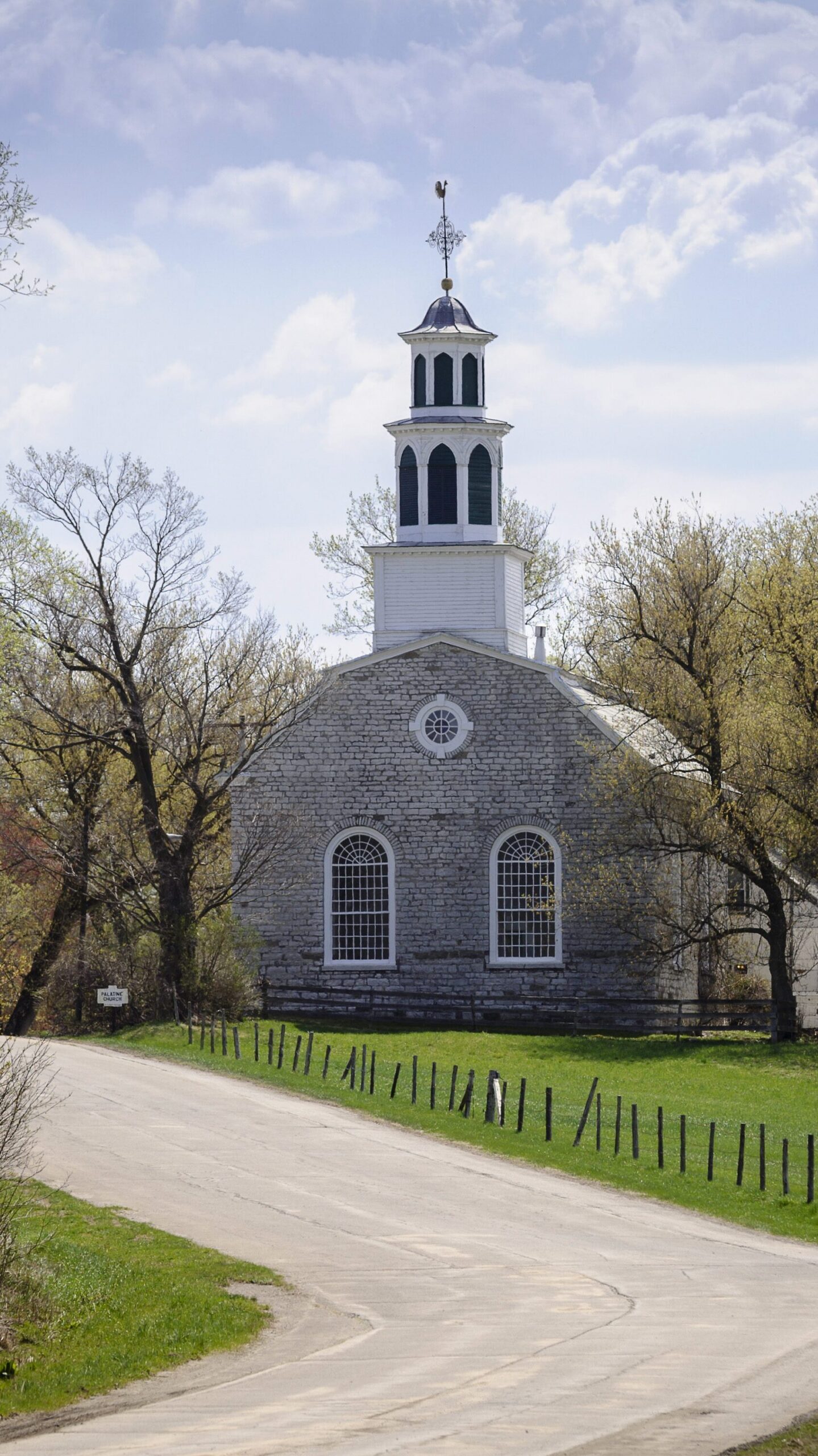
On Oct. 19, 1780, Sir John Johnson led an army of 900 Loyalists and British Regulars on an invasion of the Mohawk Valley. After following a circuitous route across southern New York State, they swept north up the Schoharie Valley and entered the Mohawk Valley at Fort Hunter, where the army turned west toward the Canajoharie/Palatine Districts. The invaders camped the evening of Oct. 18 near the Noses, a geological feature that forms the great divide in the Appalachian Mountain chain. The following day, they crossed the Mohawk River at Keator’s Rift and burned Jellis Fonda’s mill before continuing on to attack the settlement of Stone Arabia, located a mile and a half north of the Mohawk River in the Palatine District. Colonel John Brown of the Massachusetts Militia marched his 380 militiamen out of Fort Paris to meet the enemy on a field about a mile from the fort. Outnumbered nearly three-to-one, he was shot from his horse, and his men fled the field. Stone Arabia was completely destroyed by the enemy, including the twin Dutch Reformed and German Lutheran Churches. Both churches were rebuilt after the war ended and still stand today. Today, the battlefield is marked with a New York State historical marker sign. Further interpretation of the Battle of Stone Arabia can be seen at the Fort Plain Museum.
Isaac Paris House
This historic site was originally built by Isaac Paris, Jr. as a trading post and home. At the time of the Revolutionary War, Isaac’s family lived in Stone Arabia. Isaac was 15 years old when his father and brother were killed at the Battle of Oriskany. After the war, Isaac moved from Stone Arabia to Fort Plain and established his trading post. Its location in the Mohawk Valley and trails made it successful and a stop for notable figures of the time, including Continental Lt. Col. Marinus Willett and Mohawk War Chief Joseph Brant. Isaac died at age 29 in 1790. The home was sold several times following his death. In 1835, William Bleecker purchased the home. His descendants occupied the home for nearly 100 years.
In 1932, the Diefendorf family purchased the home and grounds and gave it to the Fort Plain Chapter of the National Society Daughters of the American Revolution, which continues to maintain the historic house located off Mohawk Street.
America 250 Events in Montgomery County
May 16, 2026
Opening Day at Fort Klock
7203 State Route 5, St. Johnsville, NY
May 17, 2026
Kilts Farm Open House
172 Kilts Road, Fort Plain, NY
May 31, 2026
Charleston Historical Society Presents “American Revolution Songs”
390 Polin Road, Charleston, NY
June 20, 2026
Road to 250 Revolutionary Bus Tour
241 NY-30, Amsterdam, NY
June 24, 2026
Evening Lecture: “Choosing Loyalty”
Old Fort Johnson NHL 2 Mergner Road, Fort Johnson, NY, United States
July 3, 2026
Amsterdam’s Independence Day Fest Sponsored by DANVANN
Amsterdam Riverfront Center, 1250 Riverfront Center, Amsterdam, NY
July 3, 2026
4th on the 3rd (opens in a new tab)
Fort Plain Museum & Historical Park
July 4, 2026
Independence Day Celebration (opens in a new tab)
Fort Klock Historic Restoration
July 5, 2026
Open House and Historical Talk with Richard Christman
Old Palatine Church
July 18, 2026
St. Johnsville 4th Annual Red, White & Block Party (opens in a new tab)
Bridge Street Bridge, St. Johnsville, NY
Aug. 2, 2026
Holding Down the Fort
Fort Plain Museum & Historical Park
Aug. 30, 2026
Revolutionary Collections
Fort Plain Museum & Historical Park
Timeline of Revolutionary War Events in Montgomery County
- Tryon County forms from Albany County and the first election is held; Col. Guy Johnson and Hendrick Frey are elected to the NY Assembly.
- December 8, 1772 – Tryon County Loyalty Oath.
- July 4, 1774 – Sir William Johnson criticizes the closing of Boston Harbor.
- July 11, 1774 – Sir William Johnson dies at Johnson Hall.
- August 27, 1774 – First Tryon County Committee of Safety meeting; Stone Arabia Resolves issued.
- October 27, 1774 – Jelles Fonda writes a letter and refers to the Boston Tea Party and taxation.
- May 11, 1775 – Liberty Pole uprising at Caughnawaga.
- May 12, 1775 – Second meeting of the Tryon County Committee of Safety.
- June 15, 1775 – Tryon County Militia forms.
- June 25, 1775 – John Fonda arrested by Tryon County Sheriff Alexander White for fighting.
- July 20, 1775 – Rioters free John Fonda from jail in Johnstown.
- August 11, 1775 – Sheriff White captured with letters for the British from Sir John Johnson.
- May 19, 1776 – Sir John Johnson flees to Canada.
- August 6, 1777 – Battle of Oriskany; Tryon County Militia suffers heavy casualties.
- Summer 1778 – 100 Loyalists return from Canada to collect families from Fort Hunter through Fish House, taking 11 prisoners.
- November 19, 1778 – Lt. Col. Frederick Weissenfels leaves Fishkill for Albany and then Canajoharie, where Lt. Peter Van Bunschoten and his company begin constructing Fort Plain.
- February 4–5, 1779 – Work parties from the 4th NY Regiment build Fort Plain as a temporary refuge for locals.
- April 28, 1779 – Raiding parties reported in Schoharie, Stone Arabia and near Fort Plain; militia and Continental forces march to Johnstown in response.
- June 21, 1779 – Lt. Henry Hare of Butler’s Rangers is hanged as a spy at Canajoharie for his role in the Cherry Valley Massacre.
- June 25, 1779 – Col. Dubois leaves Fort Plain with the 5th NY Regiment and artillery train for the Sullivan-Clinton Expedition into western NY.
- June 26, 1779 – Sgt. William Newberry of Butler’s Rangers is hanged as a spy at Canajoharie for his role in the Cherry Valley Massacre.
- September 20, 1779 – Col. Gansevoort of the 3rd NY Regiment is ordered to destroy the lower Mohawk castle at Fort Hunter.
- May 21, 1780 – Sir John Johnson leads 500 troops, Loyalists and Native Americans to raid the Mohawk Valley near Johnstown, Tribes Hill and Caughnawaga.
- June 13, 1780 – 4th NY Regiment orders sick and wounded removed to Johannes Lipe’s barn near Fort Plain from camp at Frey farm.
- August 2, 1780 – Women defend Fort Plain in the absence of the garrison; Brant burns 51 houses and 42 barns, with 17 killed and 52 prisoners.
- September 1780 – Malcolm’s Brigade moves into the Mohawk Valley, joined by Brown’s Mass. Levies; Col. DuBois assumes command at Fort Rensselaer.
- September 9, 1780 – Almon’s Remembrancer reports Brant’s Canajoharie raid.
- October 18, 1780 – Col. DuBois at Fort Plain learns a large enemy force is advancing toward Stone Arabia.
- October 19, 1780 – Battle of Stone Arabia; Col. John Brown is killed and Stone Arabia is burned.
- October 20, 1780 – Van Rensselaer attacks and defeats Johnson’s force at Klock’s Field.
- October 22, 1780 – Gen. Stirling orders the post to be referred to as “Fort Rensselaer” only.
- October 31, 1780 – Receipt from Christopher L. Yates shows large shipments of food arriving at Fort Plain for public use after raids.
- January 1781 – John Barr spends the 6th at Fort Plain and dines with Capt. Wright on the 7th in the home of Rev. Gros.
- April 28, 1781 – Marinus Willett assumes command of all upstate forces, using Fort Plain as headquarters.
- May 3, 1781 – Native Americans are discovered on the east side of the river; several buildings are burned and people are killed and taken prisoner.
- May 15, 1781 – Convoy leaves Fort Plain for Fort Stanwix and learns en route that Stanwix was destroyed by fire.
- July 9, 1781 – About 300 Loyalists and Native Americans led by John Doxtader attack Currytown.
- July 11, 1781 – Capt. Robert McKean dies in battle and is buried next to the unfinished blockhouse at Fort Plain.
- October 24, 1781 – Col. Willett receives word of an impending attack at Johnstown.
- October 25, 1781 – Willett leaves Fort Plain and engages enemy forces led by Ross at Johnstown.
- January 1782 – An assault force leaves Fort Plain for a planned nighttime attack on Fort Ontario at Oswego; the assault is canceled after the Americans lose their way.
- May 27, 1782 – Col. Benjamin Tupper of the 10th Mass. writes to Gen. Washington for funds to complete the Fort Plain Blockhouse.
- June 1782 – Lt. Col. Reid with the 2nd New Hampshire Regiment replaces Col. Benjamin Tupper.
- July 2, 1782 – Gen. Washington writes to the Quartermaster at Albany about the need to put Fort Plain in a state of readiness.
- October 16, 1782 – Col. Willett writes to Gen. Washington from “Fort McKean,” the nickname of the newly completed blockhouse at Fort Plain.
- May 1783 – News reaches Fort Plain of preliminary peace with Great Britain.
- June 8, 1783 – Elected officials meet at Fort Plain and resolve not to let Loyalists resettle the district.
- July 4, 1783 – Huge celebration near Fort Plain.
- July 28, 1783 – Gen. Washington receives a 13-gun salute while visiting Fort Plain.
- August 2, 1783 – Washington returns to Fort Plain after visiting the site of Fort Schuyler and Cherry Valley.
- April 2, 1784 – Tryon County is changed to Montgomery County by act of the NY Legislature.